Release from Captivity

My youngest daughter is taking a religion class in college. In anticipation of a test on the Old Testament (Hebrew Scriptures) this week, she asked me to explain it to her. A daunting task, I still looked forward to our time together. To prepare, I drew a diagram. (It’s what I do!) 

I knew, despite the early chapters of the Bible, it all began with the Exodus, the moment God delivered the Hebrew people from captivity. As I walked through the rest of the Bible, I saw deliverance from captivity was everywhere I looked. It seems to be what God cares most about. I found myself no longer thinking about my daughter’s upcoming test, but the ways I’ve been held captive in my life, as well as the countless ways God has sought to release me.

Captivity comes in all shapes and sizes. It can be found in a job that holds us in chains, a relationship that gives us little room to breathe. It can even be found in circles of friends that require certain norms to be considered worthy of membership. 

Our real captivity, however, lies deeper. Our real captivity lies within, not without. The need to be good enough, to feel lovable, are perhaps the thickest chains that bind us. No matter how hard we try to break free, no matter how many kinds of keys we put into the locks, we’re left, like the Hebrew people, to learn that there is only one who can release us from captivity. 

It’s all over the Bible, it’s all over my life, and I’m grateful to my daughter for giving me the opportunity to remember.

Christmas 2021: Being Found

I’ve had it all wrong for too long and in too many ways. When I heard about shepherds leaving their flocks and going to Bethlehem and wise men traveling months to find Christ, I thought I, too, should journey in hopes of finding God. Such thinking has led me to wonderful people and places; it has also led me to look in all the wrong places, as the song goes. What I didn’t realize until recently was that there is a fundamental flaw in such thinking. This year I am going to try to see and do things differently.

To search for God can lead one to think of God as some sort of possession or object. We go in search of God, and when (and if) we find what we are looking for we hold tightly. We lift the fruit of our search above our heads with the pride of a tournament champion. We cling to God with pride as if we are as precious as what (or who) we’ve found. In some cases, we even use it to bash others over the head.

I now see the arrogance of such searching. I can see how it becomes all about me, about the journey and effort I make, and has little or nothing to do with the God who is above all things, beyond all efforts, and surpasses all understanding. 

I’m going to change the posture of my spiritual journey this year. Instead of setting out to find God, I am going to let God find me. I’m going to open the arms of my heart and wait for God to come and complete the embrace. I am no longer going to look to a distant place or time, but look for God right where I am. I am going to try to resist the temptation to read too much, to stop conjuring up images of a God of my own making (in my own image) and let God come in whatever ways God chooses. Like a friend who says, “Okay God, I look forward to seeing how you show up in my life today” each morning, I’m ready to be surprised.

I know God is right here, right not. I know God is as eager for a relationship as I. I’ve just been too busy searching.

Advent IV: Misspellings

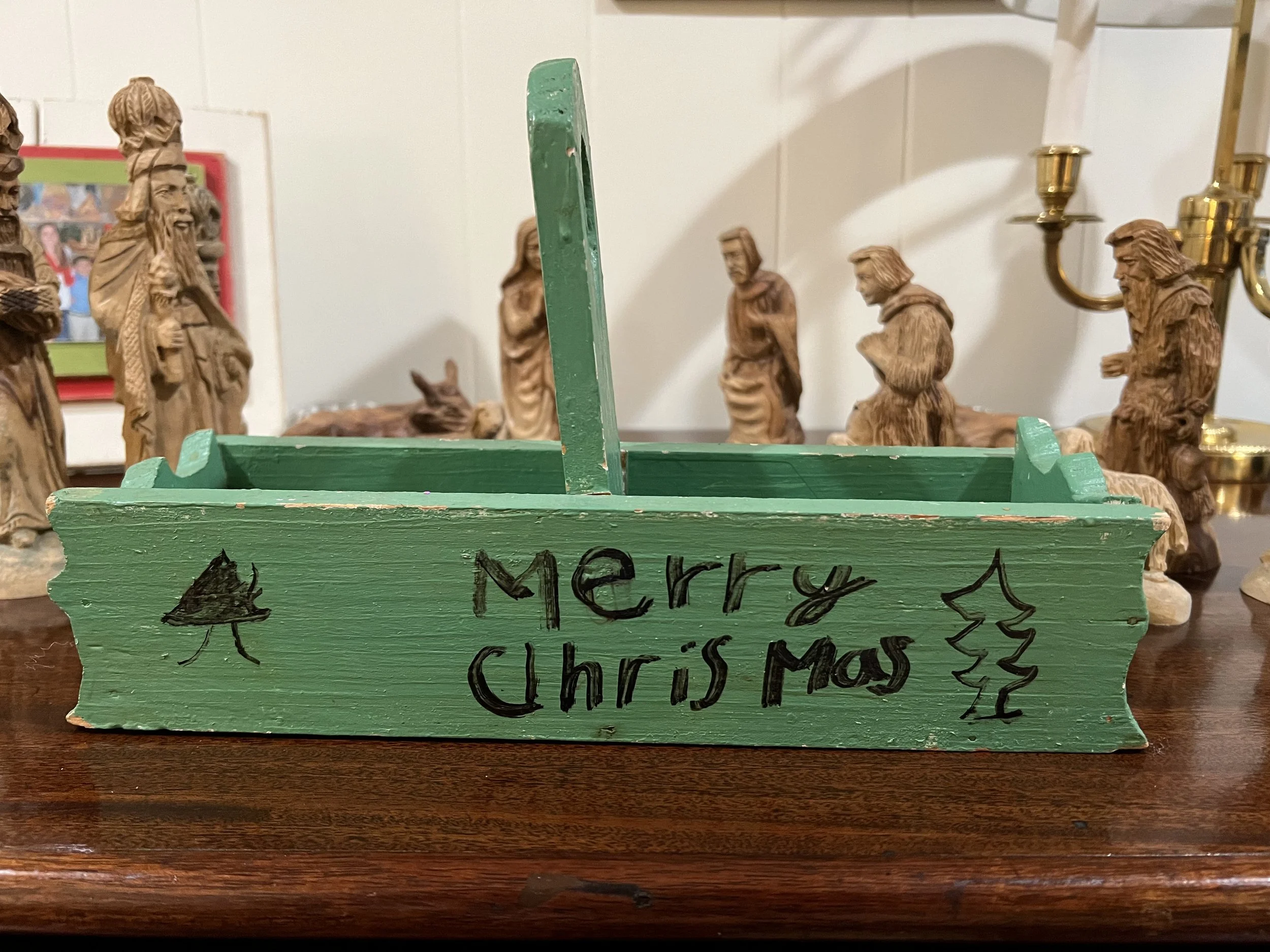
It’s has always been an annual source of embarrassment. Made in third grade, I thought it was something special. I couldn’t wait to give it to my parents for Christmas and remember squirming in my seat as they opened it years ago. My mother lifted it from the wrapped box and held it up for my father and siblings to see. I was proud, until I hear the first snicker. “You spelt Christmas wrong!” someone pointed out. My face turned red, my pride withered, and I wanted to crawl from the room.

The cracker holder now belongs to me. Each year I bring it out and remember not that moment of embarrassment and shame so much as the way my mother displayed it proudly every year. She unpacked it from the Christmas decoration boxes with reverence, as if it was a sacred relic. In her hands, the imperfect cracker holder looked wonderful. “Don’t you dare!” she said loud and clear when I suggested correcting the misspelling. She didn’t just not mind the misspelling, she cherished it. “It’s what makes it you,” she reminded me often. “I wouldn’t want it any other way.” 

The imperfect cracker holder has become special to me, too. Rather than being a reminder of my poor spelling ability, it reminds me of a parent’s love despite my imperfection. She didn’t ignore the imperfection, she embraced it. The misspelling is what made it unique, personal, genuine. No wonder she lifted it from the box the way she did each year.

I think God’s the same way. Despite our best efforts to conceal them, we are full of imperfections. God does not ignore them or look the other direction. He lifts and holds each of us like a sacred relic, smiling as only a parent can at the things that make us unique. In God’s hands, all our imperfections and things we’re embarrassed by look wonderful. I think, deep down, that’s why a child was born years ago. That’s why God didn’t wait until we got our acts together before taking his seat beside us in this thing called life. Despite our best (and continuous) efforts to hide or correct our imperfections, Christmas is a time to celebrate God coming among us and loving us the way we are.